
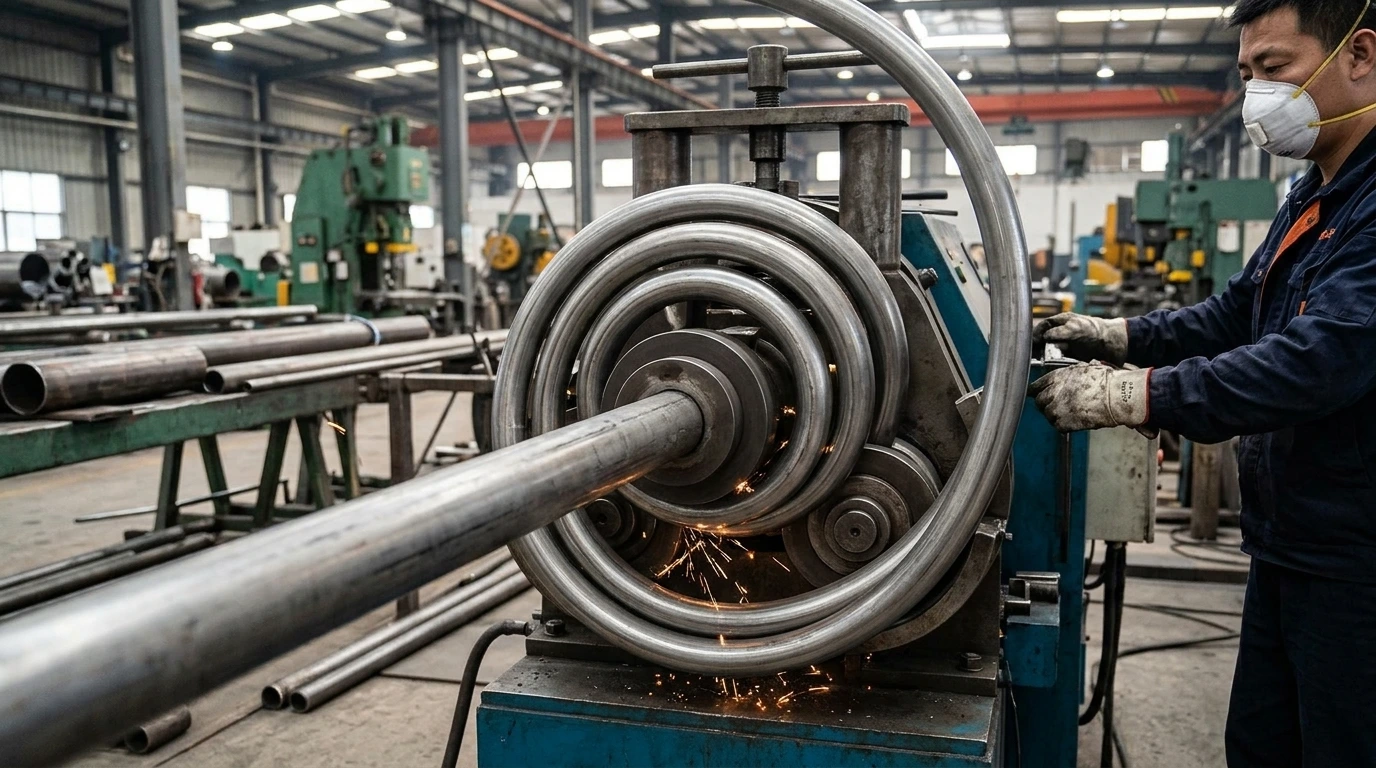
Compare custom pipe bending with Weldtech Fabrication in Newcastle to match mandrel or spiral forms with your dimensions, site and installation needs.
Poorly matched custom pipe bending geometry can leave a fabricated pipe fighting the drawing, connection points or available installation space. Mandrel bending and spiral bending produce different forms, so choosing by appearance alone can create fit, clearance or assembly problems.
What Does Your Design Need?
Mandrel bending forms a defined curve while internal tooling supports the pipe through the bend. It is generally suited to separate bends or repeated changes in direction where the radius, angle and cross-sectional shape require control.
Spiral bending forms the pipe into a continuous helix with a nominated pitch and overall diameter. The correct custom pipe bending method therefore depends on whether the drawing calls for controlled individual curves or one continuous spiral form.
How Custom Pipe Bending Matches the Required Form?
Mandrel bending can limit unwanted flattening and wrinkling, but the finished result still depends on pipe size, wall thickness, material, tooling and bend radius. Weldtech Fabrication states a mandrel-bending capacity of up to 60 mm, so larger or unusual specifications require confirmation before they are released for fabrication.
Spiral work needs more than an overall width. The drawing should identify pitch, outside diameter, height, handedness and end orientation so the formed section can connect with adjoining work. Weldtech’s published pipe-bending and fabrication services include both mandrel bending and spiral-forming capability.
Which Details Determine the Bending Method?
Clear project information lets the fabricator assess feasibility without filling gaps with assumptions. Supply these five items with the enquiry:
- Pipe dimensions: State the outside diameter, wall thickness, cut length and any dimensional tolerances that affect fit.
- Required geometry: Mark each bend angle, centreline radius, spiral diameter, pitch and straight length on the drawing.
- Material specification: Identify the material and grade because different metals and wall sections respond differently during forming.
- Connection points: Show flanges, weld locations, brackets and end orientation so the completed form aligns with adjoining components.
- Site constraints: Record access, handling limits, clearances and installation sequence before workshop dimensions are finalised.
Research on mechanical mandrel bending and pipe deformation identifies wall thickness, pipe diameter, bend radius and mandrel position as factors that influence cross-sectional change. These findings reinforce why nominal pipe size alone is not enough for a sound bending decision.
How the Wider Fabrication Scope Affects Selection?
Pipe bending may form one stage of an assembly alongside our welding, laser cutting, powder coating and CNC plate folding services. Our fabrication experience spans residential, commercial and industrial projects in Newcastle. From spiral staircases to custom equipment parts, dimensions, loading, compliance and installation conditions guide the finished work.
Choose Pipe Bending in Newcastle for the Required Geometry
Mandrel bending is the practical starting point for defined curves, while spiral bending suits a continuous helical form. Accurate drawings and complete specifications allow specialised pipe bending to be assessed against Weldtech Fabrication’s stated equipment capacity.
Send the pipe dimensions, material grade, drawing, quantity and required finish before requesting a quotation. Contact us for a clear assessment of custom pipe bending in Newcastle and the fabrication processes needed for the finished component.