
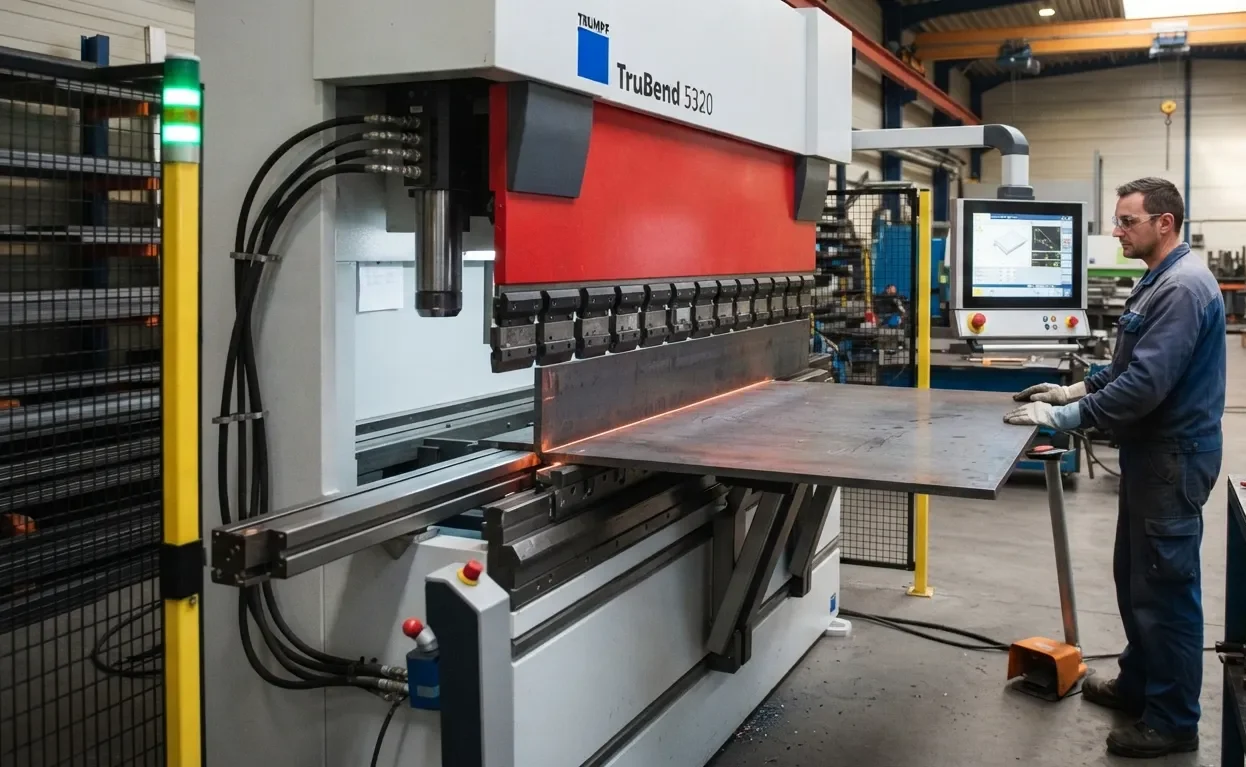
Source CNC plate folding in Newcastle for steel plate up to 20 mm, supported by laser cutting, welding and fabrication—send your drawings.
CNC plate folding uses a programmed press brake to form sheet or plate to specified bends. Weldtech Fabrication states that its Newcastle capability handles plate up to 20 mm, subject to material, bend geometry and machine limits.
What Is CNC Plate Folding?
A CNC press brake positions tooling and controls the bending cycle according to programmed dimensions. The process can improve repeatability across brackets, channels, folded sections, guards and other fabricated components. Accurate results still depend on correct drawings, material data, tooling, grain direction and bend allowances.
Weldtech Fabrication lists CNC press plate folding up to 20 mm alongside laser cutting, welding, engineering and custom fabrication. The stated thickness is not a guarantee that every 20 mm component can be folded; part length, grade, bend angle, tooling and press capacity must be assessed together.
What Information Is Needed for a Folding Quote?
- Dimensioned drawings: provide overall dimensions, bend angles, inside radii and tolerances.
- Material specification: identify the grade, thickness and any required certification rather than stating “steel” only.
- Bend orientation: show grain direction or critical visual faces where these affect manufacture.
- Quantity: separate prototypes from production quantities so setup and repeat requirements are clear.
- Downstream work: state whether parts also require cutting, welding, drilling, coating or assembly.
Why Coordinate Cutting and Folding?
Parts cut without suitable bend allowances or feature clearances can become difficult to form. Coordinating laser cutting and fabrication with folding lets the manufacturing sequence be reviewed before material is committed. Holes, slots and cut-outs near a bend may need adjustment depending on geometry.
Springback and tooling marks also vary by material and finish. If an exposed face is architecturally important, identify it on the drawing and discuss acceptable handling marks. For critical assemblies, trial components or inspection requirements should be agreed before the full batch.
Where Folded Plate Is Commonly Used
Folded plate can form components for machinery, structural fabrication, transport equipment, industrial enclosures and custom metalwork. Suitability depends on the engineered design. Weldtech can manufacture to supplied requirements, but the customer’s responsible engineer must define structural loads, material and acceptance criteria where engineering certification is required.
If traceability is required, specify it before quotation. Material certificates, inspection records, weld documentation and dimensional reports are scope items, not automatic inclusions. Naming them early lets the workshop price the required controls and preserve identification through cutting, folding and fabrication.
The national model Code of Practice for welding processes provides general safety guidance when folded parts proceed to welding. Project specifications and applicable standards still govern the finished component.
Send a Manufacturing-Ready Enquiry
Contact Weldtech Fabrication with drawings, material grade, thickness, quantities, tolerances, finish and delivery requirements. Ask for manufacturability feedback before ordering material if the bends are tight, parts are long or features sit close to fold lines. A complete brief produces a faster, more defensible quotation than broad claims that steel always outperforms another material.